PCS System Overview
Purpose
The Propulsion Control Standard (PCS) repository contains the engineering artifacts needed to develop, document, simulate, test, and deploy propulsion control software.
The repository covers:
- PLC software
- HMI integration
- simulation interfaces
- MATLAB models and algorithms
- communication interfaces
- tests
- engineering documentation
Architecture
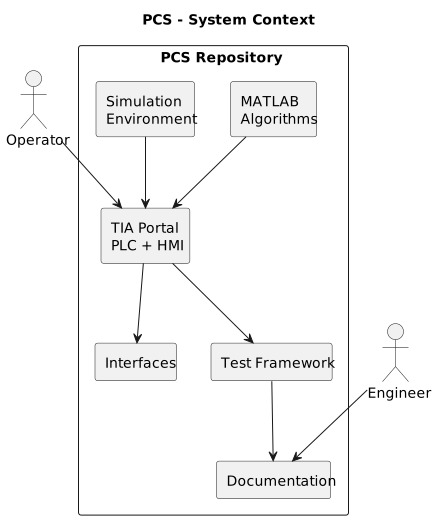
PCS is organized as a set of focused subsystems. Each subsystem owns a clear responsibility, while the complete system coordinates operator commands, propulsion state, drive interfaces, power limiting, alarms, safety, parameters, simulation, and tests.
Architecture Principles
Modularity
Subsystems should be independently understandable, testable, and replaceable where possible.
Reusability
Common algorithms, interface handling, diagnostics, and simulation helpers should be reusable across PLC targets and projects.
Testability
Core functions should be testable through simulation, automated checks, and clear commissioning procedures.
Traceability
Subsystem documentation should connect requirements, PLC implementation, HMI behavior, tests, and commissioning notes.
Main Components
| Component | Description |
|---|---|
| TIA Portal | PLC software, HMI integration, and hardware configuration |
| MATLAB | Algorithms, models, and calculation support |
| Simulation | Virtual commissioning and scenario testing |
| Interfaces | Communication with drives, HMI, SCADA, and external systems |
| Testing | Verification of PLC behavior and regression checks |
| Documentation | Engineering knowledge, decisions, and operating context |
Development Workflow
- Define requirements.
- Document the architecture.
- Implement PLC and interface functions.
- Simulate relevant operating scenarios.
- Execute tests.
- Deploy and compile in TIA Portal.
- Prepare a release.
System Context