Phase-Locked Loop
This example shows a simple synchronous-reference-frame phase-locked loop for a three-phase voltage system.
The objective is to estimate the grid angle theta_hat so the measured voltage vector aligns with the rotating d-axis. In the locked state, the q-axis voltage is driven toward zero:
The estimated angle is fed back into the abc -> dq transformation. A PI controller acts on the q-axis phase error and corrects the estimated angular frequency. The angle output is shown as a phasor-style gain/normalization block rather than a software-like modulo function, because this diagram is meant to read as an s-domain control schematic.
Block Diagram
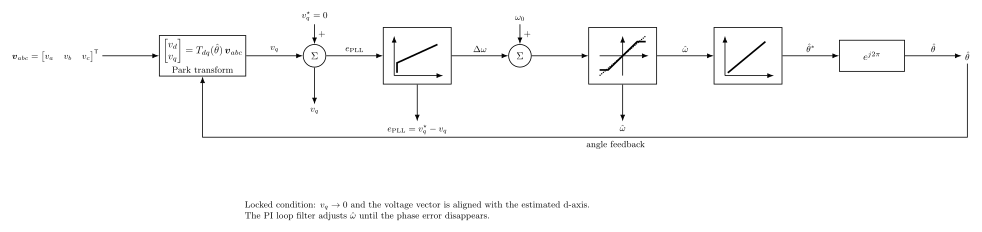
TikZ/LaTeX source: phase-locked-loop-dq.tex
Signal Meaning
| Signal | Meaning |
|---|---|
v_a, v_b, v_c |
measured three-phase voltages |
theta_hat |
estimated electrical grid angle |
v_d, v_q |
voltage components in the estimated rotating dq frame |
e_pll |
phase detector error, usually derived from v_q |
delta_omega |
frequency correction from the PI controller |
omega_hat |
estimated angular frequency |
Notes
This is a conceptual control-theory diagram. A production PLL normally adds filtering, voltage magnitude supervision, frequency limits, anti-windup, startup handling, and fault behavior for weak-grid or unbalanced-voltage conditions.
For control-theory block diagrams, TikZ/LaTeX is preferred over PlantUML because it supports mathematical notation, summing junctions, transfer functions, and precise signal-flow layout. PlantUML remains useful for architecture, workflows, state machines, and linked system diagrams.